

Why Ordinary Jeans May Not Be Enough — And How to Choose the Right Protection
Many motorcycle riders invest in a quality helmet, a protective jacket, and a good pair of gloves. Yet when it comes to trousers, ordinary jeans are often considered good enough.
After all, if you are only commuting to work, riding through the city, or heading out for a short coffee break, do you really need dedicated motorcycle riding pants?
The answer is worth thinking about.
While riding pants may not be the most exciting piece of motorcycle equipment, they protect areas of the body that are particularly vulnerable during a fall.
And unlike ordinary clothing, properly designed motorcycle trousers are built with the specific risks of riding in mind.
Your Lower Body Is More Vulnerable Than You Think
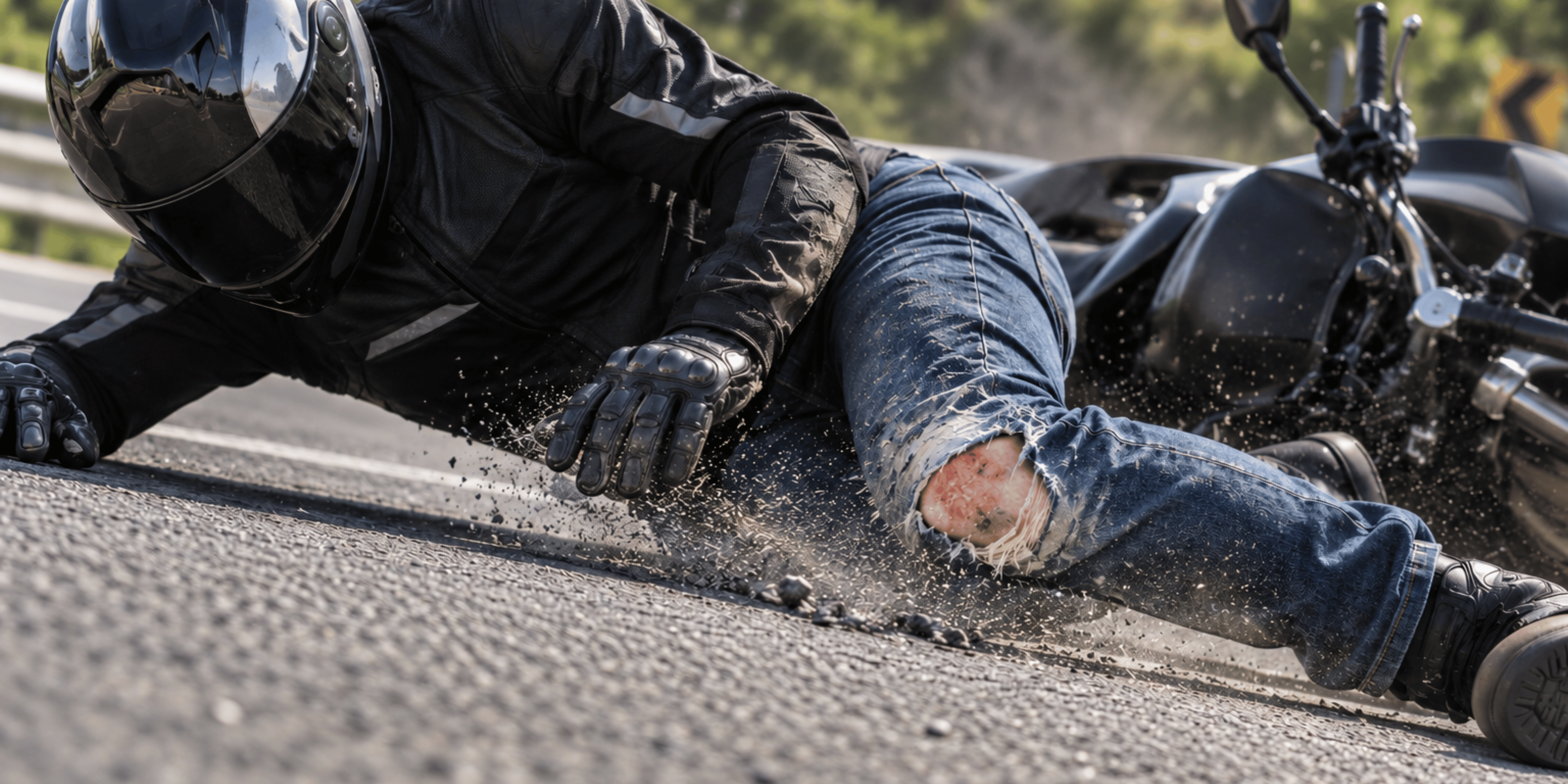
When a motorcycle falls, the rider's legs, knees, hips, and thighs can come into direct contact with the road.
Even at relatively moderate speeds, sliding across asphalt can cause painful abrasions, cuts, and other injuries.
Research published in Traffic Injury Prevention found that protective motorcycle clothing was associated with a lower risk of soft-tissue injuries. In particular, riders wearing both motorcycle trousers and boots experienced a lower risk of lower-limb soft-tissue injuries compared with riders without that combination of protection.
Protective clothing cannot prevent every injury, particularly fractures or injuries caused by severe impacts. However, it can make an important difference when it comes to reducing abrasions and lacerations.
This is why lower-body protection deserves just as much consideration as a helmet, jacket, or gloves.
Why Ordinary Jeans Are Not Enough
Denim is durable for everyday use, but ordinary fashion jeans are not specifically designed to withstand the friction and impact forces involved in a motorcycle crash.
During a slide, the fabric can wear through, tear, or expose the skin to the road surface.
Motorcycle riding pants, on the other hand, are designed with abrasion resistance and impact protection in mind.
Depending on the design, they may use reinforced denim, aramid fibres, high-strength synthetic textiles, leather, or other abrasion-resistant materials.
Many also incorporate removable impact protectors around the knees and hips.
Importantly, modern riding jeans do not necessarily look like traditional motorcycle equipment.
Some are designed to look almost identical to ordinary jeans, making them practical for commuting, casual riding, and everyday use.
The difference is not always visible from the outside.
It is in the materials, construction, and protection underneath.
Understanding CE-Certified Riding Pants
When choosing motorcycle trousers, one of the most useful things to look for is European CE certification.
The EN 17092 standard evaluates motorcycle protective garments according to requirements including abrasion resistance, tear strength, and seam strength.
The main protection classes include:
Class AAA: The highest protection classification within EN 17092, with more demanding performance requirements.
Class AA: A balance of protective performance and everyday practicality, suitable for a broad range of riding applications.
Class A: A lighter category with lower protection requirements, often used for garments designed with flexibility and comfort in mind.
Impact protectors are assessed separately under EN 1621-1, which includes Level 1 and Level 2 protection ratings.
Level 2 protectors meet stricter transmitted-force requirements than Level 1 protectors, although comfort and flexibility should also be considered.
When purchasing riding pants, check both the garment's CE classification and the included knee and hip protectors.
A pair of trousers with CE-rated knee armour does not automatically mean that the entire garment is CE-certified.
Understanding that distinction helps riders make better-informed decisions.
Protection Should Not Come at the Expense of Comfort
In Malaysia, one of the biggest challenges is the weather.
High temperatures and humidity can make heavy motorcycle clothing uncomfortable, particularly in slow-moving city traffic.
Fortunately, modern riding pants offer more practical solutions than ever before.
Lightweight textiles, ventilation panels, stretch fabrics, and ergonomic construction can improve comfort without abandoning the need for protection.
Proper riding pants are also designed around the rider's seated position.
Pre-shaped knees, flexible panels, and carefully positioned seams can help improve mobility and reduce discomfort during longer journeys.
For daily commuting, a pair of ventilated or protective riding jeans may be a practical choice.
For longer journeys or touring, textile trousers with weather protection, ventilation systems, and additional adjustment features may offer greater versatility.
The important thing is to choose protection that suits your riding environment.
Because protective equipment only works when you actually wear it.
How to Choose the Right Riding Pants
Before buying your next pair of motorcycle trousers, consider five important factors.
1. CE Certification
Look for the EN 17092 classification and understand the level of protection the garment is designed to provide.
2. Knee and Hip Protection
Check whether CE-certified protectors are included, whether they can be adjusted, and whether they remain correctly positioned when seated on your motorcycle.
3. Abrasion-Resistant Materials
Choose garments designed and tested for motorcycle use rather than relying on ordinary fashion fabrics.
4. Fit and Riding Position
Riding pants should feel comfortable both standing and sitting. They should allow natural movement without becoming excessively loose or causing the protectors to shift out of position.
5. Malaysian Riding Conditions
Consider ventilation, breathability, rain protection, and how easily the trousers can be worn throughout the day.
The most expensive pair is not necessarily the right pair.
The best choice is one that delivers suitable protection, fits properly, and works with your everyday riding habits.
Riding Pants Are Not Just for Touring
It is easy to associate protective riding pants with long-distance touring, adventure riding, or track days.
But the need for protection does not disappear simply because the journey is short.
A sudden lane change, an unexpected obstacle, a slippery road marking, or a patch of loose gravel can lead to a fall during an otherwise ordinary ride.
You do not need to be riding aggressively or travelling at high speed for protective clothing to become relevant.
That does not mean every rider needs racing leathers for a trip to the local café.
It simply means that motorcycle-specific protection should be considered part of everyday riding, rather than equipment reserved only for special occasions.
Final Thought: Dress for the Ride, Prepare for the Unexpected
Motorcycling is about freedom, enjoyment, and the experience of being on two wheels.
But being prepared is part of enjoying that freedom responsibly.
A good pair of riding pants may look ordinary, feel comfortable, and fit naturally into your daily routine.
Yet underneath that familiar appearance is equipment designed with a very different purpose from everyday clothing.
Riding pants are not about looking like a professional rider. They are about protecting yourself like a responsible one.
Because the road does not become softer just because the journey is short.
References
Effectiveness of Protective Clothing for Motorized 2-Wheeler Riders, Traffic Injury Prevention (2019).
EN 17092:2020 — Protective garments for motorcycle riders.
EN 1621-1:2012 — Motorcyclists' limb joint impact protectors.