

Why Proper Riding Gear Matters Even in the city at 40 km/h?
Many riders believe that serious riding gear is only necessary for touring, highway riding, or track use.
For city riding, it is common to think:
“I’m only going nearby.”
“I won’t be riding fast.”
“It’s just a short ride.”
“Just commuting.”
But real-world accident research tells a different story.
According to accident research referenced by SPIDI through its long-term collaboration with academic studies, a large proportion of injury-related motorcycle crashes occur in urban areas and at relatively moderate speeds — below 40 km/h.
In other words, the riding environment many people consider “normal city riding” is exactly where many real-world injuries happen.
City riding may look simple, but it is full of unpredictable risks: sudden lane changes, cars entering from side roads, buses, delivery riders, wet surfaces, painted road markings, metal drain covers, potholes, loose sand, and stop-and-go traffic.
At 40 km/h, a rider may not feel fast.
But the road is still hard.
The impact is still real.
And the body is still exposed.
That is why proper riding gear matters — even in the city.
⸻
City Riding Is Not Low-Risk Riding. Speed is only one part of the risk.
In city traffic, the rider has less space, less time to react, and more unpredictable movement around them. A car may suddenly pull out from a junction. A vehicle may change lanes without warning. A patch of diesel, sand, or water on the road can turn a normal ride into a crash within seconds.
Many city crashes are not dramatic high-speed accidents.
They are simple, sudden, low-to-medium-speed falls.
But even a simple fall can injure the hands, feet, knees, elbows, shoulders, back, or face.
This is where proper gear makes a difference.
The purpose of riding gear is not only to protect riders in extreme situations. It is also to reduce injury in the most common real-world riding situations.
And for many riders, that situation is city riding.
⸻
Expensive Gear Is Not Always the Point — Proper Gear Is.
The question is not simply whether riding gear is expensive.
The real question is whether the gear provides the right protection for the way you ride.
Not every city rider needs race-level equipment.
Not every commuter needs the same jacket as a long-distance adventure rider.
But every rider should think seriously about protection.
A proper riding jacket should provide abrasion resistance and impact protection in key areas such as the shoulders, elbows, and back. A CE-certified motorcycle jacket gives riders a clearer standard of protection compared with ordinary fashion jackets or casual outerwear.
A proper motorcycle glove should protect the palm, knuckles, fingers, and wrist area. This is especially important because riders naturally put their hands out during a fall. Without gloves, even a low-speed crash can cause painful and avoidable hand injuries.
Proper motorcycle footwear is also often underestimated. Ordinary sneakers are not designed for motorcycle crashes. A CE-certified riding shoe or boot can provide better protection for the ankle, heel, toe, and sole while still being practical enough for daily city use.
In short, proper gear does not have to mean uncomfortable or extreme gear.
It means choosing equipment that is designed for motorcycling — not just clothing that looks suitable for riding.
⸻
Why Full-Face Helmets Matter in the City
Helmet choice is especially important.
Many riders choose open-face helmets for city riding because they feel convenient, light, and comfortable in hot weather. However, open-face helmets leave one of the most vulnerable areas exposed: the lower face.
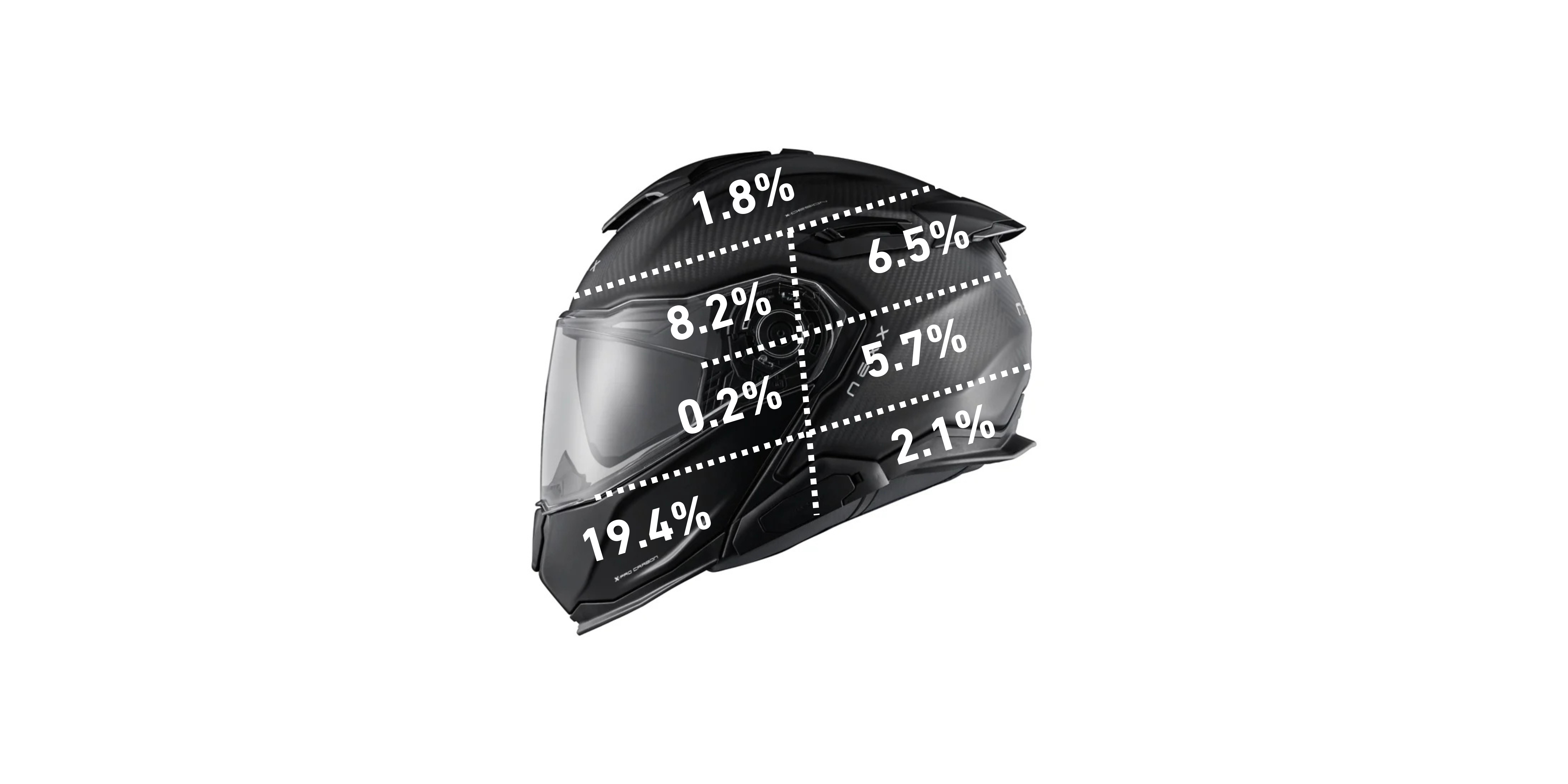
The well-known Hurt Report, one of the most influential motorcycle safety studies, investigated 900 motorcycle accidents in depth and analyzed 3,600 accident reports. The study highlighted that many motorcycle crashes involve frontal impacts, making facial protection highly relevant in real-world accidents.
A commonly cited helmet impact distribution based on motorcycle accident research shows that the chin and jaw area accounts for a large share of helmet impacts — often quoted at around 35% in total.
This is one of the clearest reasons why full-face helmets offer an important safety advantage over open-face helmets.
For Malaysian riders, this point is especially relevant. City traffic is dense, close, and unpredictable. Even when the speed is not high, a rider can still fall forward or be thrown toward the front of the motorcycle.
A full-face helmet is not only for racing.
It is not only for touring.
It is not only for high-speed riding.
It is for protecting the face in the kind of crash that can happen during normal city riding.
⸻
Comfort Is Also Safety
In Malaysia, heat and humidity are real issues.
If a jacket is too hot, riders will stop wearing it.
If gloves are too bulky, riders may leave them at home.
If shoes are uncomfortable, riders may go back to ordinary sneakers.
That is why comfort should not be treated as separate from safety.
Good city riding gear should be protective, breathable, practical, and easy to wear regularly. Mesh jackets, ventilated gloves, lightweight riding shoes, and well-ventilated full-face helmets all help riders stay protected without feeling over-equipped.
The best riding gear is not the gear that stays in your room.
The best riding gear is the gear you actually wear every time you ride.
⸻
What Should City Riders Wear?
For everyday city riding, riders should consider at least the following:
>A proper helmet: Full-face or modular helmet with proper safety certification and a secure fit.
>A motorcycle jacket: CE-certified, with shoulder and elbow protectors, and preferably a back protector.
>Motorcycle gloves: CE-certified, designed for riding, with palm and knuckle protection.
>Riding shoes: CE-certified, with ankle, heel, toe, and sole protection.
>Protective pants or knee protection: Especially for riders who commute daily or ride in heavy traffic.
This does not mean every rider needs to dress like a racer for a coffee run.
It means that riders should protect the parts of the body most likely to hit the ground in a real-world crash.
⸻
Final Thought
City riding can feel familiar, routine, and harmless.
But familiarity does not remove risk.
Many real-world motorcycle injuries happen not during extreme riding, but during ordinary rides in ordinary traffic. That is why proper riding gear should not be seen as overkill for city riding.
Premium riding gear is not about showing off.
It is not about riding fast.
It is not about buying the most expensive equipment available.
It is about protection, comfort, and consistency.
The best riding gear is the gear that offers real protection, suits your riding environment, and is comfortable enough to wear every time.
Because even in the city, riding is still riding.